
🔥 Next Stock Market Crash Prediction 2026: Is a Major Market Crash Coming or Just Fear?
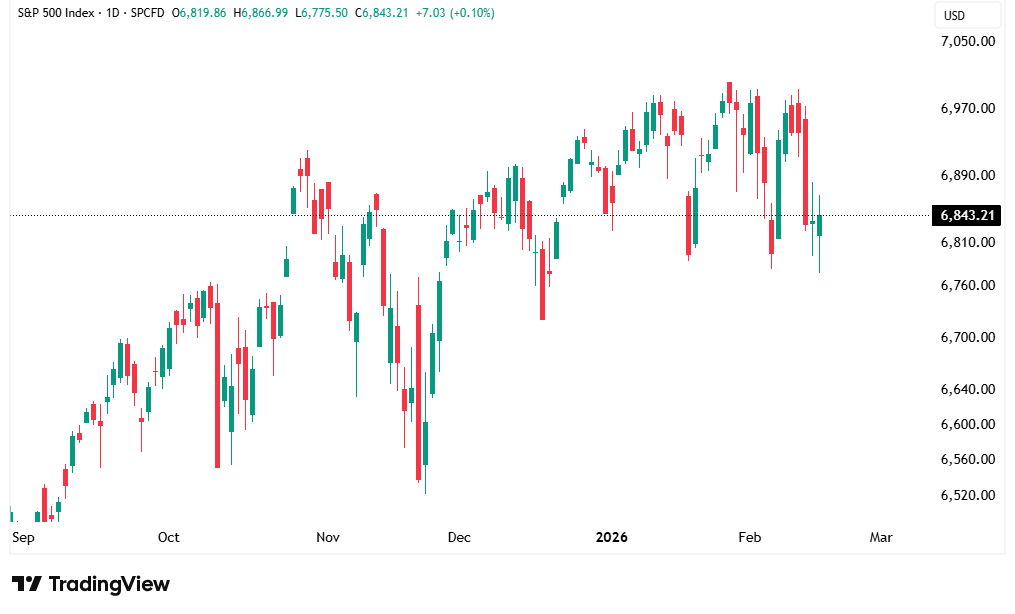
Right now, investors are confused. In early 2026, the S&P 500 touched record highs but recently struggled to break above the 7,000 level. Technology stocks have shown weakness, while energy and defensive sectors are outperforming. Market volatility has increased, and sentiment indicators show rising anxiety.
On February 17 (solar eclipse day), social media predictions about a “major crash” went viral. However, despite the dramatic forecasts, markets remained relatively stable, moving slightly up or flat — not collapsing.
So what is really happening?
According to a 2026 MarketWise investor survey, 76% of investors fear a crash this year, and 46% say they feel unprepared for a recession. After two strong bull years, many are asking:
- Are valuations too high?
- Is economic growth slowing?
- Is this the beginning of a major correction?
- Or is this simply a normal market cycle?
Instead of panic-based opinions or viral headlines, this article analyzes:
- Historical crash patterns
- Current economic data
- Valuation signals
- Bull vs. bear expert arguments
- Realistic risk factors for 2026
Our goal is simple: provide evidence-based, balanced analysis so you can make informed investment decisions — not emotional ones.
Let’s separate fear from facts.
Where Is the Stock Market Right Now? (February 2026 Market Snapshot)
Before predicting a crash, we must understand one simple rule: crashes don’t happen in isolation — they develop from conditions. Understanding how markets function daily — including trading sessions and volatility hours — is equally important. If you’re unsure about global trading hours, read our guide on what time the market opens and the best hours to trade.
📊 Current Market Position
As of mid-February 2026:
- The S&P 500 remains slightly positive year-to-date
- However, it has declined around 1–2% in recent weeks
- The recent pullback qualifies as a minor correction, not a structural breakdown
There is no panic selling, no credit freeze, and no systemic stress visible at the moment.
📈 Earnings Strength: A Key Support
Corporate earnings continue to surprise on the upside:
- Most companies have beaten earnings expectations
- This marks the fifth consecutive quarter of double-digit profit growth
- Analysts currently forecast 11–15% earnings growth in upcoming quarters
Strong earnings are historically one of the biggest supports for equity markets. Major crashes usually require either collapsing earnings or financial system stress — neither is visible yet.
🔄 Sector Rotation: A Healthy Shift?
One of the biggest changes in 2026 is sector leadership.
For the past two years, mega-cap technology and AI-related stocks dominated market gains. Now we are seeing rotation:
- Technology is among the weaker sectors recently
- Industrials, energy, and consumer staples are outperforming
- The equal-weight S&P 500 is performing better than the market-cap weighted index
This matters.
When gains spread beyond a few mega stocks, it often signals a broadening rally, which is generally considered healthier than narrow leadership.
⚖️ The Valuation Concern
Despite solid earnings, valuations remain elevated:
- Forward P/E ratio is around 21.5
- This is above long-term historical averages
High valuations do not automatically cause crashes — but they reduce the margin of safety. If economic growth slows or earnings disappoint, downside reactions can be sharper.
🧠 What This Means
At this moment:
- The market is not crashing
- Earnings remain supportive
- Rotation suggests internal strength
- But valuations leave less room for error
In short: conditions are mixed, not extreme.
The real question is not whether volatility exists — it always does.
The real question is whether risk factors are building beneath the surface.
Lessons from Past Market Crashes – What History Teaches Smart Investors
Before believing any crash prediction for 2026, it’s important to understand one fact: market cycles are normal — panic is not.
Stock_markets have always moved in waves of optimism and fear. Every major crash in history felt shocking at the time, and almost always, people believed “this time is different.”
📉 Major Historical Market Crashes
Let’s briefly review key examples:
- 1929 – The Great Depression: Excess speculation and leverage led to one of the worst economic collapses in history.
- 2000 – Dot-Com Bubble: Overvalued tech stocks crashed after unrealistic growth expectations failed.
- 2008 – Global Financial Crisis: Housing market collapse and banking system failure triggered a severe bear market.
- 2022 – Inflation & Rate Shock: Rapid interest rate hikes caused a sharp bear market, especially in tech stocks.
Each crash had different causes — but one common pattern:
Extreme valuations + economic imbalance + tightening financial conditions = higher crash risk.
📊 What History Says About Market Drops
Data shows:
- The S&P 500 experiences an average 14% intra-year decline, even in positive years.
- Bull markets typically last 5 to 7 years.
- The current bull cycle began after the 2022 lows — meaning 2026 marks year four.
Historically, year four of a bull market is often still positive. However, corrections of 10% or more are common, even during strong cycles.
Bear markets (20%+ declines) tend to occur every few years — but they are part of the long-term growth process.
📈 The Most Important Lesson: Recovery
Here is what many fear-driven predictions ignore:
After every major crash in modern history, markets eventually recovered and reached new highs.
- After 1929 → markets recovered over time
- After 2000 → new highs came in 2007
- After 2008 → markets hit record highs in the 2010s
- After 2022 → markets rebounded strongly
The long-term trend of the stock_market has historically been upward — despite temporary crashes.
🧠 What This Means for 2026
History does not guarantee that a crash won’t happen.
But it teaches three critical lessons:
- Corrections are normal.
- Fear peaks near market bottoms.
- Long-term investors who stay disciplined are historically rewarded.
Instead of asking, “Will there be a crash?”
A smarter question is: “If a correction happens, am I prepared?”
What Experts Are Saying About 2026 – Separating Optimism from Risk
When markets feel uncertain, expert opinions become louder.
Some analysts see continued expansion and steady returns. Others warn that complacency is building before a major downturn. Instead of choosing sides emotionally, let’s compare both perspectives objectively.
Understanding both bullish and bearish arguments helps investors avoid bias — and make informed decisions.
Bullish vs Bearish Outlook for 2026: A Balanced Breakdown
🟢 Bullish Views (Mainstream Wall Street Outlook)
Most major investment banks currently lean optimistic about 2026.
Morgan Stanley
- Describes the current bull market as being in its fourth year — historically still constructive.
- Believes AI-driven productivity gains continue supporting earnings.
- Expects the Federal Reserve to remain relatively dovish, with possible rate cuts supporting liquidity.
- Base case: Continued growth, no major crash.
Goldman Sachs
- Forecasts approximately 7–10% stock returns in 2026.
- Projects around 10% earnings growth.
- Estimates recession probability near 25%, meaning expansion remains the base scenario.
JP Morgan & Other Major Institutions
- Suggest potential double-digit gains in global equities.
- Highlight strong corporate earnings and resilient consumer spending.
- Note that labor markets remain stable, reducing immediate recession risk.
Overall mainstream expectation:
Moderate returns, occasional corrections, but continued upward trend.
Importantly, even bullish analysts acknowledge that 10% corrections are normal and healthy within a growing market.
🔴 Bearish & Contrarian Warnings
While most institutions remain positive, several respected voices urge caution.
Marc Chaikin (Wall Street Veteran)
- Estimates a 65% probability of a bear market (20%+ drop) in 2026.
- Argues that AI enthusiasm mirrors past speculative peaks like:
- 1920s radio boom
- 1990s internet bubble
- His view: Late-cycle optimism often precedes sharp declines.
Ray Dalio (Founder, Bridgewater Associates)
- Warns of potential “capital war” risks.
- Points to geopolitical tensions that could disrupt global capital flows.
- Notes that rising borrowing costs and supply chain fragmentation could pressure growth.
- Suggests that heavy AI concentration increases systemic vulnerability if momentum breaks.
David Rosenberg (Economist)
- Highlights a contrarian signal:
When almost no economists predict recession, risk may be underestimated. - Historically, extreme consensus optimism has sometimes preceded downturns.
🌐 Other Market Voices
- Some independent analysts project a 10–20% correction if valuations compress.
- Concerns about an “AI bubble” remain active in alternative research circles.
- Social media fear cycles (like the February 17 eclipse crash prediction) show how quickly sentiment can amplify — even without fundamental triggers.
However, so far, dramatic crash predictions have not materialized.
What This Really Means
Right now, expert opinion is divided — but not chaotic.
- Mainstream institutions expect moderate growth.
- Contrarians warn about valuation, concentration risk, and geopolitical stress.
- No clear systemic breakdown is visible yet.
Historically, markets tend to fall not when fear is loud — but when risk builds quietly beneath confidence.
Possible Triggers for a Stock Market Crash in 2026
No serious analyst can predict the exact timing of a crash.
However, risk assessment is possible.
Instead of guessing, smart investors monitor probability drivers — the types of events that historically increase the chances of a correction or bear market.
Here are the most realistic risk factors for 2026:
🌍 1. Geopolitical Escalation
Global tensions remain elevated.
Potential risks include:
- Expansion of existing wars
- U.S.–China trade friction or tariff increases
- Capital flow restrictions between major economies
- Sanctions or supply chain disruptions
Ray Dalio’s “capital war” thesis highlights how financial fragmentation between major powers could disrupt global liquidity.
Historically, markets can absorb political noise — but sudden escalation increases volatility quickly.
🤖 2. AI Bubble Risk
Artificial Intelligence is currently one of the biggest investment themes.
Companies have committed hundreds of billions of dollars (estimated $500B+) toward AI infrastructure, chips, and data centers.
The risk is not AI itself — the risk is expectations.
If:
- Revenue growth slows
- Profit margins disappoint
- Monetization takes longer than expected
Then highly valued AI-related stocks could correct sharply.
Past innovation cycles (railroads, radio, internet) show that transformative technology can still experience painful valuation resets.
💳 3. High Debt & Interest Rate Sensitivity
Global debt levels remain elevated.
If:
- Bond yields rise unexpectedly
- Inflation resurges
- The Federal Reserve delays rate cuts
- Or financial conditions tighten
Borrowing costs increase for corporations and consumers.
Higher financing costs reduce earnings growth and pressure stock valuations.
Markets are currently pricing stable-to-lower rates. Any policy surprise could trigger repricing.
📉 4. Inflation or Recession Risk
Current recession probability estimates range between 20%–35%, depending on the model.
If consumer spending weakens significantly:
- Corporate revenues decline
- Earnings expectations fall
- Investor sentiment shifts rapidly
The U.S. economy remains resilient — but late-cycle slowdowns are common in year 4–5 of expansions.
📊 5. Elevated Valuations
The market’s forward P/E ratio around 21+ suggests optimism.
High valuations do not cause crashes alone.
But when markets price near-perfect outcomes, even small disappointments can trigger sharp sell-offs.
This creates a lower margin of safety compared to undervalued environments.
Important Reality Check
None of these risks guarantee a crash.
They increase the probability of:
- A 10% correction (common)
- A 15–20% drawdown (possible)
- A full bear market (less common, but not impossible)
Crashes typically require multiple risks aligning at the same time — not just one headline event.
What Should Investors Do in 2026? Practical, Evidence-Based Steps
Market uncertainty does not require panic.
It requires discipline.
History shows that emotional decisions during volatility often hurt long-term returns more than the correction itself. Instead of reacting to headlines, investors should focus on strategy.
Here are practical steps supported by long-term market data:
1️⃣ Avoid Panic Selling
Selling everything during fear rarely works.
Even professional fund managers struggle to time:
- The exact top
- The exact bottom
- The recovery phase
Missing just a few strong rebound days can significantly reduce long-term returns.
Unless your financial situation has changed, panic liquidation is usually not a strategy — it’s an emotional reaction.
2️⃣ Diversify Beyond One Theme
Concentration risk increases volatility.
If most of your portfolio is in AI or mega-cap tech, consider balance:
- Value stocks
- Dividend-paying companies
- International markets
- Bonds or fixed-income assets
For new investors looking to start small and reduce risk, you can explore our list of best stocks for beginners with little money in 2026 to build a diversified base. Sector rotation in 2026 already shows leadership shifting. A diversified portfolio handles rotation better.
3️⃣ Keep Strategic Cash Available
Cash is not just safety — it is optionality.
Market corrections create discounted opportunities in high-quality businesses.
Having some liquidity allows you to:
- Buy during fear
- Avoid forced selling
- Reduce stress during volatility
However, staying 100% in cash long-term usually reduces purchasing power due to inflation.
Balance is key.
4️⃣ Focus on Quality Companies
During corrections, weaker companies fall harder.
Strong businesses with:
- Healthy cash flow
- Low debt
- Competitive advantages
- Consistent earnings growth
tend to recover faster and outperform over full cycles.
Quality reduces downside risk.
5️⃣ Think Long Term (Use SIP / Dollar-Cost Averaging)
Systematic Investment Plans (SIP) or Dollar-Cost Averaging strategies help reduce timing risk.
By investing consistently:
- You buy more shares when prices fall
- You buy fewer shares when prices rise
- Volatility works in your favor over time
Historically, long-term disciplined investors outperform emotional traders.
6️⃣ Follow the Buffett Principle
Warren Buffett’s famous rule remains relevant:
“Be fearful when others are greedy, and greedy when others are fearful.”
When markets are euphoric, reduce risk gradually.
When fear dominates headlines, look for opportunity — carefully.
7️⃣ Use Risk Tools — But Avoid Overtrading
Stop-loss orders can help manage downside risk.
However:
- Frequent trading increases costs
- Emotional decision-making increases mistakes
- Over-monitoring increases stress
Instead, consider:
- Annual portfolio rebalancing
- Reviewing asset allocation once or twice a year
- Adjusting exposure based on life goals, not headlines
Final Thoughts: Will the Stock Market Crash in 2026?
So, is a stock market crash in 2026 guaranteed?
No.
At this stage, data does not confirm an inevitable collapse.
Mainstream institutions continue to project moderate growth supported by:
- AI-driven productivity expansion
- Ongoing corporate earnings strength
- Stable (or potentially easing) Federal Reserve policy
However, ignoring risk would also be a mistake.
Contrarian voices like Marc Chaikin, who estimates a 65% bear market probability, and surveys showing 76% of investors fear a crash, highlight an important reality:
Markets are forward-looking — and uncertainty always exists.
Valuations are elevated. Geopolitical tensions remain. AI expectations are high. Debt levels are significant. These factors don’t guarantee a crash — but they justify caution.
The Bigger Historical Perspective
What history clearly shows is this:
- Crashes are temporary.
- Recoveries are powerful.
- Long-term disciplined investors are rewarded.
Every major downturn — 1929, 2000, 2008, 2022 — eventually led to new highs.
The difference between those who build wealth and those who lose confidence is not prediction skill.
It is preparation and emotional control.
If you:
- Diversify properly
- Avoid panic decisions
- Focus on quality assets
- Think long term
You don’t need to fear volatility — you can navigate it.
In markets, uncertainty is permanent. Opportunity is too.
Disclaimer: This article is for informational and educational purposes only. It does not constitute financial, investment, or trading advice. Market predictions are uncertain, and past performance does not guarantee future results. Always conduct your own research and consult a qualified financial advisor before making any investment decisions. Investing in stocks involves risk, including the potential loss of principal.



1 thought on “🚨 Next Stock Market Crash Prediction 2026: Is This the Calm Before a Major Market Drop?”
Pingback: NVIDIA Stock Split History (2000–2026): How the 10-for-1 Split Changes Investor Strategy