Density of Gold – Value, Formula, Comparison, and Why It Matters
Gold has fascinated humans for thousands of years. From ancient coins and jewelry to modern investments and electronics, this precious metal holds immense value. One reason gold feels so unique compared to other metals is its extraordinary density. If you have ever held a small gold bar or coin, you might have noticed how surprisingly heavy it feels for its size.
Gold is a chemical element represented by the symbol Au, which comes from the Latin word aurum, meaning “shining dawn.” In chemistry and materials science, gold is recognized as a noble metal known for its high density, corrosion resistance, and excellent conductivity.
But what exactly is the density of gold, and why is it so important in science, jewelry, and gold trading?
In this guide, we will explore the exact density value of gold, how it is calculated, how it compares to other metals, and why understanding gold density helps identify real gold.
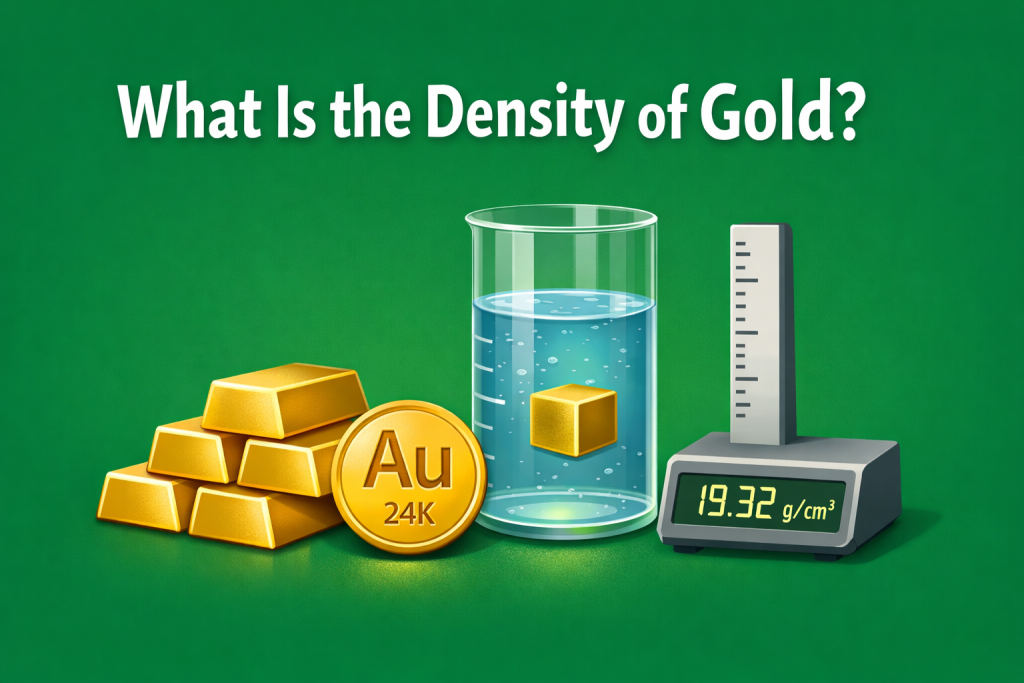
What Is the Density of Gold?
Density is a physical property that tells us how much mass is packed into a specific volume of a substance. In simple words, it shows how heavy a material is for its size.
For gold, the density is very high compared to most metals.
Exact Density of Gold
The density of pure gold is:
19.32 grams per cubic centimeter (g/cm³) at 20°C
This means that one cubic centimeter of pure gold weighs 19.32 grams.
In other units:
- 19.32 g/cm³
- 19,320 kg/m³
- 0.698 lb/in³
According to the World Gold Council, gold’s unique physical properties such as its high density and corrosion resistance are some of the reasons it has been valued for thousands of years.
Because of this high density, even a small piece of gold can feel very heavy.
Density vs Weight – What Is the Difference?
Density and weight are often confused, but they are not the same thing.
Weight refers to how heavy an object is due to gravity, while density describes how much mass is packed into a specific volume.
For example, a small piece of gold may weigh more than a much larger piece of aluminum because gold has a much higher density. This is why gold feels unusually heavy for its size.
Why Gold Has a High Density
Atomic Structure of Gold
Gold is a chemical element with the atomic number 79, meaning each gold atom contains 79 protons in its nucleus. This high atomic number contributes to the large atomic mass of gold atoms. Because each atom is relatively heavy and tightly packed, gold has a much higher density compared to many other metals.
Gold belongs to the transition metals group in the periodic table, alongside metals such as copper and silver. However, gold stands out because of its significantly higher density and strong metallic bonding.
Gold is one of the densest naturally occurring metals, and several factors contribute to this property:
1. High Atomic Mass
Gold atoms are very heavy compared to many other elements.
2. Closely Packed Atomic Structure
The atoms in gold are tightly packed together, which increases the amount of mass in a small space.
3. Metallic Bonding
Gold atoms bond strongly with each other, creating a compact structure.
These characteristics make gold significantly heavier than many common metals.
Density of Pure Gold vs Gold Alloys
Pure gold is referred to as 24-karat gold, and it has the highest density. However, most jewelry is not made from pure gold because pure gold is soft.
When other metals are mixed with gold, the density changes.
Typical densities include:
- 24K Gold: ~19.32 g/cm³
- 18K Gold: ~15–16 g/cm³
- 14K Gold: ~12–14 g/cm³
Since alloys contain lighter metals like silver, copper, or nickel, their density becomes lower than pure gold.
Density of Gold in Different Units
Different industries and scientific fields use different units to express density.
Density in g/cm³
This is the most commonly used unit in chemistry and material science.
Density of gold = 19.32 g/cm³
This means a cube of gold measuring 1 cm × 1 cm × 1 cm weighs 19.32 grams.
Density in kg/m³
In the International System of Units (SI), density is often expressed in kilograms per cubic meter.
Density of gold = 19,320 kg/m³
This unit is frequently used in physics and engineering calculations.
Density in lb/in³
In the United States, density is sometimes expressed in pounds per cubic inch.
Density of gold ≈ 0.698 lb/in³
Although less common, it is still used in certain industrial applications.
Formula to Calculate Density of Gold
Density is calculated using a simple formula used in physics and chemistry.
Density Formula
Density = Mass ÷ Volume
Where:
- Mass is the weight of the object
- Volume is the amount of space the object occupies
Example Calculation
Imagine a gold sample that weighs 193.2 grams and has a volume of 10 cubic centimeters.
Using the formula:
Density = 193.2 ÷ 10
Density = 19.32 g/cm³
This confirms that the sample is likely pure gold.
How Jewelers Measure Gold Density
Jewelry experts often use a technique called the water displacement method.
Steps include:
- Weigh the gold item using a digital scale.
- Measure the volume of water in a container.
- Place the gold in the water and observe the change in volume.
- Use the density formula to calculate the result.
If the density is close to 19.32 g/cm³, the metal is likely pure gold.
Density of Gold Compared to Other Metals
One of the easiest ways to understand gold’s density is by comparing it with other metals.
| Metal | Density (g/cm³) | Comparison With Gold |
| Gold | 19.32 | Reference value |
| Tungsten | 19.25 | Almost same density as gold |
| Lead | 11.34 | Much lighter than gold |
| Silver | 10.49 | Nearly half the density of gold |
| Copper | 8.96 | Less than half the density of gold |
| Iron | 7.87 | More than two times lighter than gold |
As you can see, gold is significantly denser than most metals.
For example:
- Gold is almost twice as dense as silver
- Gold is more than twice as dense as iron
This explains why a small gold bar feels heavier than a larger object made of other metals.
Gold Density vs Tungsten – Why Fake Gold Is Hard to Detect
Tungsten is one of the few metals with a density very close to gold. The density of tungsten is about 19.25 g/cm³, which is extremely similar to gold’s density of 19.32 g/cm³.
Because of this similarity, tungsten is sometimes used in counterfeit gold bars where a tungsten core is coated with real gold. Simple density tests may not always detect this type of fake gold.
For this reason, professional bullion testing often uses advanced techniques such as ultrasound scanning, X-ray fluorescence, and electrical conductivity tests to verify authenticity.
Does Temperature Affect the Density of Gold?
Like most materials, gold’s density can change slightly with temperature.
Thermal Expansion
When temperature increases, metals expand slightly. This means the volume increases while the mass remains the same.
As a result, density decreases slightly at higher temperatures.
However, the change is usually very small and does not significantly affect most practical uses.
Standard Reference Temperature
To keep measurements consistent, scientists measure the density of gold at 20°C (68°F).
This is considered the standard reference temperature for density values.
Why the Density of Gold Is Important
Gold density plays a critical role in several industries.
Identifying Real Gold
One of the most common uses of density measurement is detecting fake gold.
Since gold has such a high density, counterfeit metals usually fail the density test.
For example:
- Brass
- Copper
- Gold-plated metals
These materials are much less dense than real gold.
Jewelry Manufacturing
Jewelers use density to:
- Verify gold purity
- Estimate the gold content in jewelry
- Calculate manufacturing costs
This helps ensure that customers receive genuine gold products.
Gold Trading and Bullion Verification
In the gold investment market, density testing helps verify:
- Gold bars
- Gold coins
- Bullion authenticity
Investors and banks sometimes use ultrasonic tests and density measurements to confirm the metal is real.
Traders who analyze gold charts often use price action tools and candlestick patterns to understand potential market reversals and trading opportunities.
How to Test Gold Density at Home
Although professional equipment is more accurate, you can perform a basic density test at home.
Water Displacement Method
This is the simplest and most common technique.
Steps:
- Weigh the gold item using a precise digital scale.
- Fill a measuring cylinder with water.
- Record the initial water level.
- Place the gold item in the water.
- Measure the new water level.
The difference between the two measurements is the volume of the object.
Then apply the density formula:
Density = Mass ÷ Volume
If the result is close to 19.32 g/cm³, the item may be real gold.
Digital Scale Method
Some modern jewelers use digital scales that measure density directly.
These tools are faster and provide more accurate results.
Accuracy Tips
To improve accuracy:
- Use distilled water
- Remove air bubbles from the metal surface
- Use a high-precision scale
- Measure volume carefully
Even small errors in measurement can affect the final density calculation.
Interesting Facts About Gold Density
Gold’s density leads to some fascinating facts.
Gold is Extremely Heavy for Its Size
A small gold bar can weigh several kilograms despite being compact.
Gold Is Denser Than Lead
Many people think lead is one of the heaviest metals, but gold is significantly denser.
Fake Gold Often Fails Density Tests
Gold-plated metals usually have much lower density, making them easier to detect.
A Cubic Meter of Gold Is Incredibly Heavy
A cube of gold measuring one meter on each side would weigh over 19 metric tons.
Why Gold Sinks in Water
Gold sinks in water because its density is much higher than the density of water. Water has a density of about 1 g/cm³, while gold has a density of 19.32 g/cm³. Since gold is nearly 19 times denser than water, it easily sinks instead of floating.
These properties make gold unique among metals.
Conclusion
Gold is famous not only for its beauty and value but also for its exceptionally high density. With a density of 19.32 g/cm³, gold is one of the densest naturally occurring metals on Earth.
This property explains why small gold objects feel surprisingly heavy and why density testing is often used to verify gold authenticity. From jewelry manufacturing to bullion trading, understanding the density of gold plays an important role in ensuring purity, value, and trust in the gold market.
Whether you are a student, investor, or jewelry enthusiast, knowing how gold density works can help you better understand one of the world’s most valuable metals.