EMA vs SMA: Which Moving Average Works Best in Forex?
EMA vs SMA is a popular debate among forex traders looking to improve entry timing and reduce false signals. Both indicators help identify trends and reversals, but their effectiveness depends on market conditions, timeframe, and volatility.
Many beginners rely on crossovers without considering these factors, leading to frustration during ranging markets. Neither EMA nor SMA is always superior — the key is knowing when and how to use them.
- EMA (Exponential Moving Average) reacts quickly to recent price changes, ideal for scalpers and intraday traders.
- SMA (Simple Moving Average) smooths out short-term fluctuations, preferred by swing and long-term traders focusing on overall trend.
In this guide, you’ll learn:
- Key differences between EMA vs SMA
- When each gives stronger forex signals
- Strategy setups with entry and exit rules
- Common mistakes to avoid
- How to combine EMA and SMA for better results
By the end, you’ll know how to apply them strategically based on timeframe, volatility, and trading style.
What Is a Moving Average in Forex?
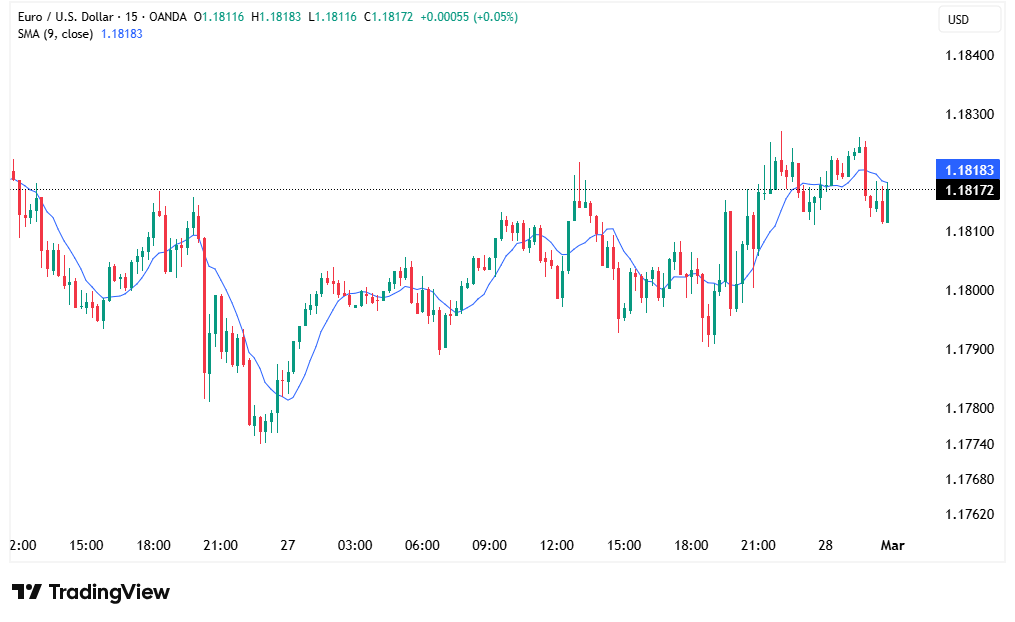
A moving average is a trend-following (lagging) indicator that smooths historical price data to help traders identify the underlying market direction. Instead of reacting to every small price fluctuation, it filters out short-term noise and provides a clearer view of momentum.
Traders use it to:
- Identify trend direction
- Find dynamic support/resistance
- Spot crossovers for trade entries
- Confirm trades
Types:
- SMA (Simple Moving Average): Equal weight to all periods; smoother but slower.
- EMA (Exponential Moving Average): More weight to recent prices; faster reaction, better for short-term setups.
Understanding these calculations is essential — signal speed, reliability, and false breakout frequency depend on them.
EMA vs SMA: Key Difference
The main difference lies in how price is calculated:
- EMA: Reacts faster, giving earlier entries but more false signals in ranging markets.
- SMA: Slower but smoother, reducing noise and confirming longer-term trends.
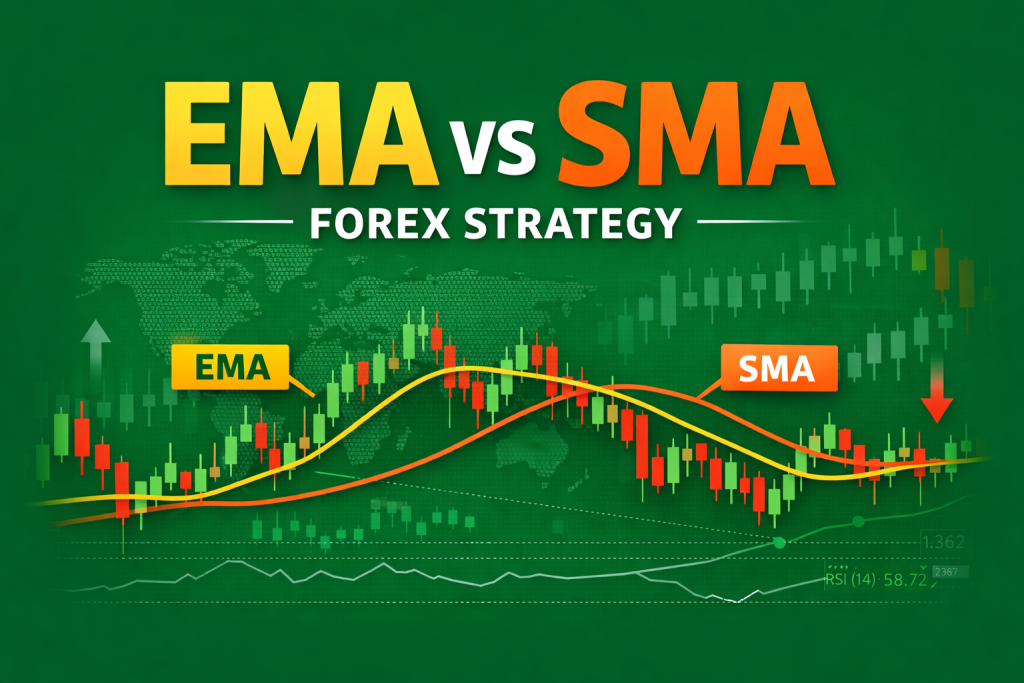
In fast markets, 20 EMA tracks price closely, while 50 SMA lags. Choosing the right MA affects your risk-reward and trade timing.
EMA vs SMA: Which Moving Average Performs Better in Forex?
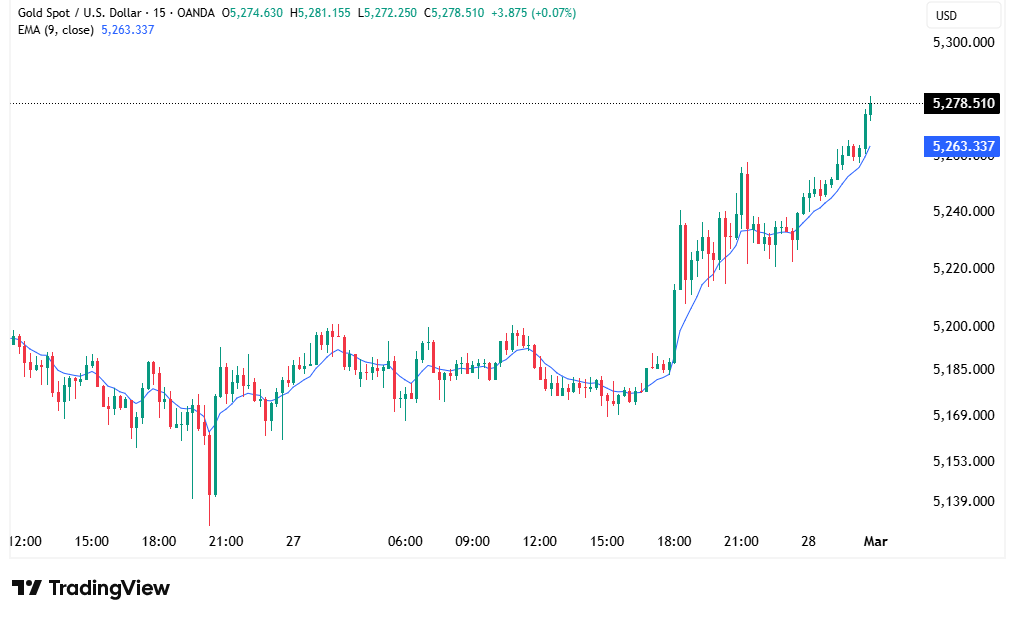
There is no universal winner in the EMA vs SMA debate. Performance depends heavily on:
- Timeframe
- Market condition (trending vs ranging)
- Volatility level
- Trading style
From a practical standpoint:
Day Trading & Scalping
Traders operating on lower timeframes (M5–M30) often prefer 9 EMA or 20 EMA, because faster reaction time allows earlier entries in momentum-based setups. However, these signals require strict risk management to avoid whipsaws.
Swing Trading & Trend Following
For H4 and Daily charts, 50 SMA and 200 SMA are commonly used to define dominant trend direction. The 200 SMA, in particular, is widely monitored by institutional traders as a long-term trend filter.
Combination Approach (Advanced Method)
Many experienced traders combine both:
- Use EMA for entry timing
- Use SMA for trend confirmation
For example:
Trade only EMA pullbacks when price is above the 200 SMA. This filters out counter-trend trades and improves probability.
The key insight is this:
EMA vs SMA is not about which indicator is superior — it’s about aligning signal sensitivity with market structure.
EMA vs SMA Forex Strategy Examples
1. Moving Average Crossover Strategy
One of the most widely used methods in an EMA vs SMA forex strategy is the crossover setup. This approach attempts to capture shifts in trend direction.
SMA Crossover Strategy (50 & 200 SMA)
When the 50 SMA crosses above the 200 SMA, it forms a Golden Cross, signaling potential bullish momentum. When the 50 SMA crosses below the 200 SMA, it forms a Death Cross, indicating possible bearish continuation.
This setup is more reliable on higher timeframes (H4 or Daily) where market noise is reduced.
EMA Crossover Strategy (9 & 20 EMA)
For intraday traders, faster combinations such as 9 EMA and 20 EMA are commonly used. Because EMAs react quicker to price movement, they can provide earlier signals — but they also require tighter risk control to avoid false breakouts during ranging markets.
Crossover strategies work best in trending conditions and tend to underperform during consolidation phases.
2. EMA Pullback Strategy in Forex
The EMA pullback strategy is popular among day traders because it aligns entries with existing momentum.
Basic framework:
Identify a strong trend (higher highs in an uptrend, lower lows in a downtrend).
Wait for price to retrace toward the 20 EMA or 50 EMA.
Enter in the direction of the trend once momentum resumes (e.g., bullish rejection candle in an uptrend).
Many traders use EMA as dynamic support or resistance because price often respects it during strong trends. However, this strategy performs best when volatility is healthy and the market is not sideways.
3. SMA for Long-Term Trend Confirmation
Swing and position traders often rely on the 200 SMA to define the dominant market bias.
Price above 200 SMA → Long-term bullish structure
Price below 200 SMA → Long-term bearish structure
Rather than using it for precise entries, the 200 SMA is typically used as a trend filter. This helps traders avoid counter-trend trades and reduces overtrading in choppy conditions.
Knowing the best trading hours can improve the effectiveness of EMA pullbacks and crossovers—check our guide on forex market hours for more details.
Instead of promoting platforms heavily, it’s better to keep it neutral:
These strategies can be applied on most trading platforms that support customizable moving averages and multiple timeframe analysis.
While EMA and SMA strategies can be applied on any platform, choosing reliable brokers with good execution and trading cashback offers can reduce trading costs.
Best Moving Average Settings for Forex Trading
There is no universal “best” setting in the EMA vs SMA debate. The effectiveness of a moving average depends largely on timeframe and market structure.
Here are commonly used settings based on trading style:
Scalping / Intraday Trading
- 9 EMA
- 20 EMA
- 50 EMA
Shorter EMAs react quickly to price changes, making them suitable for lower timeframes (M5–M30). However, they require disciplined risk management due to increased signal frequency.
Swing Trading
- 50 SMA
- 100 SMA
These settings help smooth short-term fluctuations and provide clearer directional bias on H1–H4 charts.
Long-Term / Trend Following
- 200 SMA
The 200 SMA is widely used as a long-term trend filter. Many institutional traders monitor this level, which is why price often reacts strongly around it.
Some traders apply a 3-moving-average strategy (short, medium, and long-term) to filter entries. For example, taking trades only when shorter averages align above or below a long-term average.
EMA and SMA as Dynamic Support and Resistance
Beyond crossovers, moving averages are frequently used as dynamic support and resistance levels.
In strong uptrends, price often retraces toward the 20 EMA or 50 SMA before continuing higher.
In downtrends, these same levels may act as dynamic resistance.
However, moving averages function best as support or resistance during trending conditions. In sideways markets, price tends to cross them repeatedly, reducing their reliability.
Common Problems with Moving Averages in Forex
While useful, moving averages are not flawless. Traders should understand their limitations:
Lagging Nature
Both EMA and SMA are based on historical data, meaning signals always occur after price has already moved.
False Crossovers in Ranging Markets
During consolidation, frequent crossovers can produce multiple losing trades.
Over-Optimization
Constantly changing periods (9, 14, 21, 50, etc.) without proper backtesting often leads to curve-fitting rather than improved performance.
For this reason, experienced traders typically combine moving averages with price structure, momentum indicators (such as RSI or MACD), and proper risk management rules.
Trading false breakouts or late signals can test your patience—understanding trading psychology helps manage emotions during such scenarios.
EMA vs SMA: Best Practices
To use EMA vs SMA effectively:
- Choose settings based on timeframe and volatility.
- Use EMA for faster entries and SMA for broader trend confirmation.
- Avoid overfitting indicator periods without testing.
- Combine with price action and key support/resistance zones.
- Apply consistent risk management (stop-loss and risk-reward rules).
The key is not finding the “perfect” moving average, but applying it consistently within a structured trading plan.
Final Thoughts on EMA vs SMA in Forex Trading
The EMA vs SMA debate is not about choosing the “best” indicator — it’s about understanding market context.
EMA provides speed and earlier signals, which can be powerful in trending, high-volatility environments.
SMA offers smoother confirmation and helps traders stay aligned with the broader market structure.
The real edge does not come from the indicator itself. It comes from:
- Applying the right moving average to the right timeframe
- Avoiding trades in ranging markets
- Using proper risk management
- Combining indicators with price structure
No moving average will eliminate losses. But when used correctly within a structured trading plan, both EMA and SMA can improve decision-making and consistency.
Mastering EMA vs SMA is not about prediction — it’s about probability and discipline.
Understanding moving averages is only one part of building a complete strategy. You may also find it helpful to review our article on currency pair types, where we explain how major, minor, and exotic pairs differ in volatility and structure.
Disclaimer: Trading forex involves risk. This article is for educational purposes only and does not constitute financial advice. Always trade responsibly and use proper risk management.