
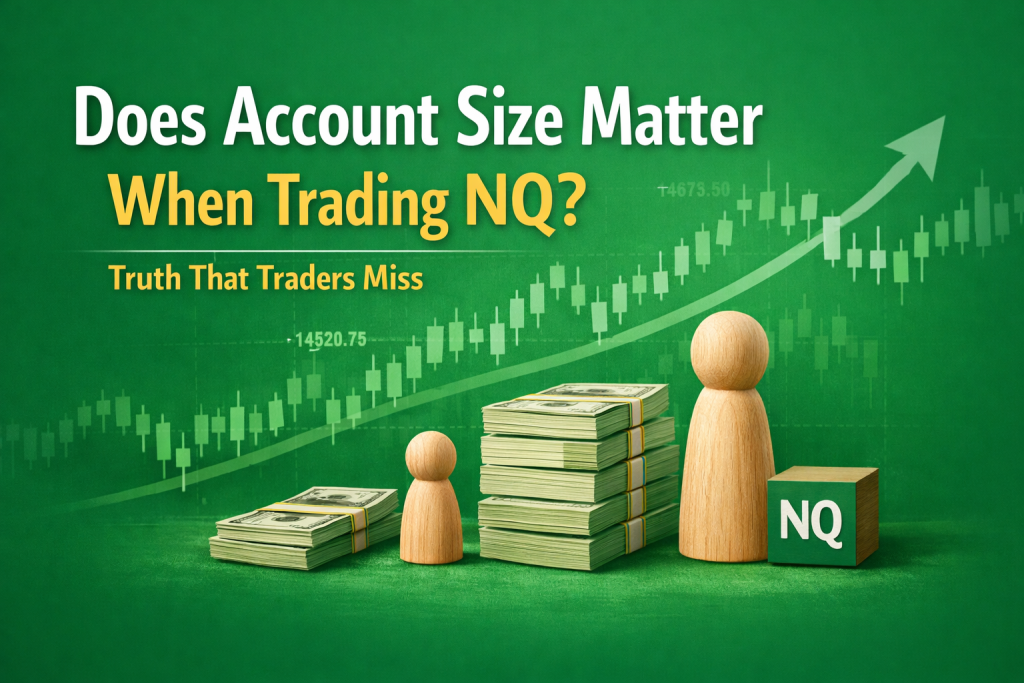
Does Account Size Really Matter When Trading NQ? The Truth Most Traders Discover After Losing Money
If you trade or plan to trade NQ (Nasdaq futures), sooner or later this question hits you:
Does account size really matter when trading NQ?
Some traders say account size doesn’t matter at all.
Others claim you must have a big account to survive NQ volatility.
The truth sits somewhere in the middle — and most traders learn it the hard way.
This article gives you a real, experience-based answer, not hype. By the end, you’ll clearly understand:
- when account size matters
- when it doesn’t
- and what actually matters more than money when trading NQ
What Makes NQ Different From Other Futures Contracts
Before answering the account size question, you need to understand why NQ is special.
NQ (Nasdaq-100 futures) is known for:
- fast price movement
- sharp spikes
- deep pullbacks
- strong trends followed by violent reversals
Compared to ES, NQ:
- moves more points in less time
- reacts aggressively to news and volume
- punishes hesitation and emotional decisions
Each point on NQ has real dollar impact, and stops can get hit quickly if risk is not controlled.
This is why traders feel NQ is “harder” — not because it’s bad, but because it exposes weaknesses faster.
Does Account Size Matter When Trading NQ? The Direct Answer
Let’s be clear and honest.
Yes, account size does matter when trading NQ — but not in the way most traders think.
A bigger account does not:
- fix bad strategy
- improve poor execution
- control emotions automatically
But a very small account can limit:
- proper risk management
- logical stop placement
- psychological stability
So the real issue is not big vs small.
It’s whether your account size allows you to trade NQ correctly.
Can You Trade NQ With a Small Account? What’s Realistic
Many traders ask:
“Can I trade NQ with a small account?”
The honest answer:
Yes — but only under strict conditions.
Small accounts usually face:
- tight margin requirements
- limited room for stop losses
- pressure to overtrade
Even trading micro NQ contracts, volatility can still move fast enough to hurt poor risk planning.
A common mistake is thinking:
“I’ll just trade smaller size.”
But if your stop is too tight because of account size, you’ll get stopped out even on good trades.
This leads to frustration, revenge trading, and blown accounts.
The Hidden Risk Most Small NQ Accounts Ignore
Most small-account NQ traders don’t fail because of strategy.
They fail because of hidden risks, such as:
- slippage during fast moves
- spread widening during volatility
- emotional decision-making under pressure
NQ doesn’t give you much time to think.
If your account is so small that every tick feels painful, your decision quality drops.
This is where account size indirectly matters — through psychology.
How Account Size Changes Risk Management on NQ
Account size affects how well you can manage risk, not how smart you are.
With a reasonable account size, you can:
- place stops logically, not emotionally
- risk a small percentage per trade
- stay consistent during drawdowns
Risk management is not guessing — it’s math.
This is where tools matter. Many traders underestimate their risk simply because they don’t calculate it properly. Using a lot size calculator helps you control exposure instead of trading on hope.
When risk is controlled, account size becomes a support, not a crutch.
Large Account Advantage: It’s Not What Most Traders Think
Many believe:
“If I had a bigger account, I’d be profitable.”
That’s not true.
A large account only gives:
- more breathing room
- less emotional pressure
- flexibility in execution
But it also creates new dangers:
- overconfidence
- oversizing trades
- ignoring rules because “I can afford it”
Some of the worst losses happen in large accounts because discipline breaks down.
So yes, larger accounts help — only if discipline already exists.
Prop Firm Accounts vs Personal Accounts When Trading NQ
Because of account size issues, many traders choose prop firms for NQ.
Prop firm advantages:
- access to larger capital
- predefined risk rules
- lower personal financial risk
But there’s a trade-off:
- strict drawdown limits
- pressure to follow rules perfectly
- less freedom in strategy testing
Personal accounts offer freedom, but require strong self-control.
There’s no “better” option — only what fits your trading personality and experience level.
Common Myths About Account Size and NQ Trading
Let’s clear some dangerous myths.
Myth 1: You need a huge account to trade NQ
False. You need a well-managed account.
Myth 2: Small accounts grow faster on NQ
False. Small accounts usually blow faster.
Myth 3: Account size matters more than strategy
False. Strategy + execution + risk > account size.
Believing these myths leads traders to gamble instead of trade.
What Experienced NQ Traders Focus On Instead of Account Size
Experienced traders rarely obsess over account size.
They focus on:
- trade quality, not quantity
- execution timing
- risk consistency
- emotional control
They also rely on accurate calculations, not estimates. Even small miscalculations compound over time.
Professional traders aim for survival first, profits second.
Why Platform and Execution Matter More Than You Think
Another overlooked factor is platform efficiency.
Fast markets like NQ demand:
- stable execution
- clean order placement
- reliable tools across devices
Many traders underestimate how much platform familiarity affects performance. Understanding your trading platform deeply reduces mistakes — especially when markets move fast.
This guide explains that mindset well: https://guriforex.com/metatrader-4-secrets-how-to-trade-smarter-on-any-device/
The better your execution environment, the less account size pressure you feel.
So, What Account Size Actually Makes Sense for Trading NQ?
There is no universal number.
A reasonable account size:
- allows logical stop placement
- supports proper position sizing
- keeps emotions manageable
If your account forces you to:
- trade too big
- move stops emotionally
- revenge trade
then it’s not ready for NQ — regardless of balance.
Sometimes the smartest decision is waiting, practicing, and building consistency before scaling.
Final Verdict: Account Size Matters — But Only If You Understand Why
So, does account size matter when trading NQ?
Yes — but only as a tool, not a solution.
Account size:
- won’t fix bad habits
- won’t replace discipline
- won’t guarantee profits
But the right account size:
- supports good decisions
- reduces emotional pressure
- allows proper risk management
If you focus on process over money, NQ becomes manageable — even powerful.
And if you ignore process, no account size will save you.
One Last Thought
The goal is not to trade NQ as soon as possible.
The goal is to trade NQ correctly.
When you do that, account size stops being the main question — and consistency becomes the answer.
Disclaimer:
Trading NQ (Nasdaq futures) involves significant risk and is not suitable for every investor. The information in this article is for educational purposes only and reflects the author’s personal experience and opinions. It does not constitute financial, investment, or trading advice. Always conduct your own research, consider your financial situation, and consult with a licensed financial advisor before making any trading decisions. Past results do not guarantee future performance.
FAQs
Does account size really matter when trading NQ?
Yes, account size matters, but mainly because it affects risk management and emotional control. A larger account gives more flexibility, while a very small account can force poor decisions.
Can beginners trade NQ with a small account?
Beginners can trade NQ with a small account, but it is risky. NQ’s fast movement can quickly expose poor risk management and emotional trading.
What is the minimum account size needed to trade NQ?
There is no fixed minimum, but your account must be large enough to place logical stop losses and risk only a small percentage per trade without pressure.
Is NQ more risky than ES for small accounts?
Yes, NQ is generally more volatile than ES, which makes it harder for small accounts to handle sudden price movements and drawdowns.
Does a larger account guarantee profitability in NQ trading?
No, a larger account does not guarantee profits. Profitability depends on strategy, execution, and discipline, not just account balance.
Are prop firm accounts better for trading NQ?
Prop firm accounts can help traders access larger capital, but they come with strict rules. They suit disciplined traders who can follow risk limits consistently.
Why do small NQ accounts fail so often?
Small NQ accounts often fail due to tight stops, emotional pressure, overtrading, and underestimating volatility rather than poor strategy alone.
What matters more than account size when trading NQ?
Execution quality, risk management, emotional control, and consistency matter far more than account size in NQ trading.
Should I trade micro NQ contracts with a small account?
Micro NQ contracts reduce exposure, but they are still volatile. Proper risk management is still essential, even when trading micros.
When should a trader avoid trading NQ?
A trader should avoid NQ if their account size forces oversized risk, emotional decisions, or prevents proper stop-loss placement.


4 thoughts on “Does Account Size Matter When Trading NQ? Truth That Traders Miss”
Pingback: Buy Stop or Sell Stop? Why Most Beginners Lose Trades Before Entry | GuriFx
Pingback: Why Stop Outs Happen and How They Can Wipe Out Your Trading Account
Pingback: Margin Called Meaning: Why Traders Lose Accounts Without Realizing It
Pingback: Why Renewable Energy Stocks Are the Smartest Investment for 2026