Buy Stop vs Sell Stop Orders: The Beginner Error That Turns Trades Into Losses
If you are new to trading, chances are you have heard terms like buy stop, sell stop, buy stop limit, or sell stop limit and felt confused. Many beginners place these orders without fully understanding how they work, and this misunderstanding often leads to unnecessary losses.
The truth is simple:
Stop orders are not dangerous. Ignorance is.
In this guide, you will learn what buy stop and sell stop orders really are, how they differ from limit orders, and when to use each one correctly. Everything is explained in simple English, with real trading logic—not theory.
Why Misunderstanding Stop Orders Causes Most Trading Losses
Most beginner traders enter the market emotionally. They see price moving fast and jump in without a plan. Later, they discover that price reversed, their stop was hit, or their order didn’t execute as expected.
This usually happens because:
- They don’t understand where to place stop orders
- They confuse stop orders with limit orders
- They trade breakouts without understanding confirmation
Professional traders don’t predict the market.
They prepare for it.
Stop orders help traders:
- Enter strong trends
- Catch breakouts
- Protect capital
- Avoid emotional decisions
Once you understand them, they become powerful tools instead of risky mistakes.
Stop orders work best when they are part of a structured trading plan, not random decisions, which is why professional traders always follow a clear trading framework.
What Is a Buy Stop Order? (Simple Explanation With Example)
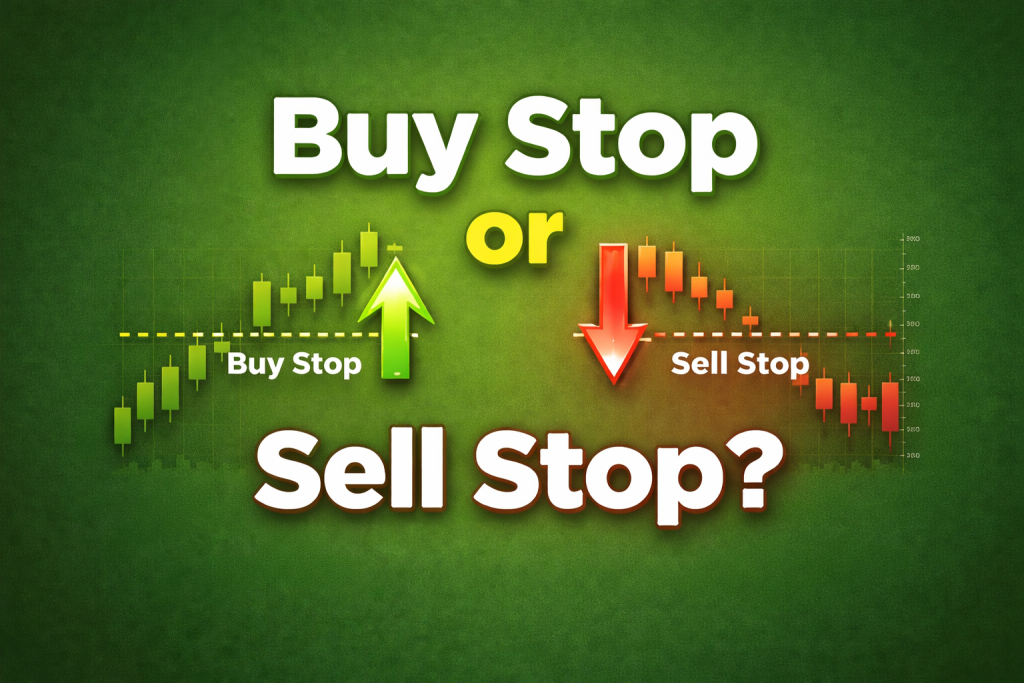
A buy stop order is an order placed above the current market price.
Simple definition:
A buy stop order tells your broker:
“Buy only if the price goes higher.”
This order is commonly used when traders expect price to continue moving up after a breakout.
Real example:
- EUR/USD is trading at 1.1000
- Strong resistance is at 1.1050
- You expect price to break above resistance and continue upward
You place a buy stop order at 1.1060
If price reaches 1.1060:
The order activates
You enter the trade in an upward move
If price never reaches it:
You stay out of the market
When buy stop works best:
- Breakout trading
- Strong bullish momentum
- Trend continuation strategies
When buy stop fails:
- False breakouts
- Ranging or sideways markets
- High-spread or low-liquidity conditions
What Is a Sell Stop Order? (The Hidden Tool for Trend Traders)
A sell stop order is placed below the current market price.
Simple definition:
A sell stop order tells your broker:
“Sell only if the price goes lower.”
This order is ideal for traders who want to enter downtrends or breakdowns.
Real example:
- GBP/USD is trading at 1.2800
- Strong support is at 1.2750
- You expect price to break support and continue falling
You place a sell stop order at 1.2740
If price breaks support:
Your order triggers
You enter a bearish move
Why professionals use sell stop orders:
- To trade momentum, not hope
- To avoid selling too early
- To confirm bearish strength
Buy Stop vs Buy Limit – One Enters Strength, One Buys Weakness
This is one of the most misunderstood concepts in trading.
Buy Stop:
- Placed above market price
- Used to enter strength
- Best for breakouts
Buy Limit:
- Placed below market price
- Used to buy pullbacks or dips
- Best in ranges or retracements
Simple mindset difference:
- Buy stop says: “I’ll buy if the market proves me right.”
- Buy limit says: “I’ll buy cheaper and wait.”
Which is better for beginners?
Beginners often do better with buy stop orders because:
- They follow momentum
- They reduce emotional entries
- They confirm trend direction
Sell Stop vs Sell Limit – Which One Protects You Better?
Many traders confuse these two and use the wrong one.
Sell Stop:
- Placed below current price
- Used to catch breakdowns
- Momentum-based
Sell Limit:
- Placed above current price
- Used to sell at resistance
- Counter-trend or pullback-based
Key difference:
- Sell stop waits for weakness
- Sell limit assumes reversal
If you are a beginner, sell stop orders are safer because they trade confirmation, not prediction.
What Is a Buy Stop Limit Order? (Advanced But Powerful)
A buy stop limit order combines two orders:
- Buy stop (activation price)
- Buy limit (execution price)
How it works:
- Price hits the stop level → order activates
- Trade executes only at your limit price or better
Why traders use it:
- To avoid slippage
- To control entry price during volatility
Downside:
If price moves too fast, your trade may not execute at all.
Best use case:
- High-impact news
- Fast-moving markets
- Advanced traders only
For another perspective on how buy stop orders are used to capture trend momentum and breakouts, you can check this explanation from a forex marketplace educational page.
What Is a Sell Stop Limit Order? (Risk Control Explained)
A sell stop limit works the same way, but for selling.
Why professionals prefer it:
- Better price control
- Reduced slippage risk
- Useful in volatile conditions
Risk:
- Order might not fill
- Missed trade opportunities
Stop limit orders are precision tools, not beginner tools.
You can also explore how a sell stop limit order functions in forex trading with an educational resource from FXTM UK.
Buy Stop vs Sell Stop – When Should You Use Each One?
Use Buy Stop when:
- Market is trending up
- Price is near resistance
- You expect continuation
Use Sell Stop when:
- Market is trending down
- Price is near support
- Breakdown is likely
Avoid both when:
- Market is sideways
- Spread is too high
- Volume is low
For a clear comparison of how buy limit vs sell stop orders work in real markets, you can reference this explanation from Investopedia’s trading dictionary.
Common Stop Order Mistakes That Kill Trading Accounts
Even good traders make mistakes, but beginners repeat them.
Many traders blame brokers for losses, but in reality, poor stop placement is one of the main reasons stop outs happen again and again.
Most common errors:
- Placing stops too close
- Ignoring spread
- Trading during low liquidity
- Using stops emotionally
Stop orders should be placed based on market structure, not fear.
Are Stop Orders Safe? What Professionals Do Differently
Stop orders are safe if used correctly.
Professional traders:
- Always calculate risk first
- Use proper position sizing
- Accept losses as part of the game
- Never move stops emotionally
They understand that capital protection is more important than profit.
Even the best stop order strategy can fail if your account size and position sizing are not aligned with proper risk rules.
Final Thoughts – Which Order Type Should You Learn First?
If you are a beginner:
- Learn buy stop and sell stop first
- Avoid stop limit orders initially
- Focus on trend confirmation
Once you gain experience, you can explore stop limit orders for precision trading.
Stop orders are not a risk management system by themselves; they only work when combined with smart risk management rules.
Disclaimer: Trading forex, stocks, and other financial instruments involves significant risk and may not be suitable for all investors.
The information provided in this article is for educational purposes only and does not constitute financial or investment advice. Market conditions can change rapidly, and past performance does not guarantee future results. Always do your own research, use proper risk management, and consult a qualified financial advisor before making any trading decisions.
Frequently Asked Questions
Are buy stop and sell stop orders safe for beginners?
Yes, when used with proper risk management and clear market structure, stop orders are safer than emotional market entries.
Why do professional traders prefer stop orders?
Because stop orders allow traders to enter confirmed momentum instead of guessing reversals.
Can stop orders fail in real markets?
They can fail during low liquidity or false breakouts, which is why confirmation and timing matter.
Do brokers manipulate stop orders?
No, losses usually happen due to poor placement, high spread, or volatile conditions—not broker manipulation.
Should beginners use stop limit orders?
Not initially. Stop limit orders require experience and are better suited for advanced traders in volatile markets
.What is the biggest mistake beginners make with stop orders?
Placing stop orders without understanding market structure, spread, and risk per trade.