Seeing a Negative Spread? Here’s What Every Trader Must Know
Trading looks simple from the outside, but once you open a real trading platform, many confusing terms appear on the screen. One of the most confusing things for new traders is seeing numbers that do not look normal. A positive spread is expected, but sometimes traders see a minus sign in front of the spread. This instantly creates fear and confusion.
Many beginners think something is wrong with their account or broker. Others believe they are getting free profit. Both ideas are usually incorrect. To trade safely, it is important to understand what spread really means, why it changes, and how negative spread works in real market conditions.
This guide explains everything step by step in very simple English, so even a beginner can understand it clearly.
What Is a Spread in Trading?
In trading, the spread is the difference between two prices:
- Bid price – the price at which you can sell
- Ask price – the price at which you can buy
The spread is calculated like this:
Ask price – Bid price = Spread
For example:
- Bid price: 1.1000
- Ask price: 1.1002
- Spread: 2 pips
This spread is the basic cost of entering a trade. Even before price moves, you start slightly in loss because of this difference.
Why Spread Exists in the Market
Spread is not a mistake or trick. It exists because:
- Brokers need to earn money
- Liquidity providers quote different prices
- Market conditions change constantly
In some accounts, brokers earn through spread. In others, they offer very low spreads and charge commission instead. Either way, spread is part of normal trading.
Normal Spread vs Unusual Spread
Under normal market conditions:
- Spread is positive
- Spread stays stable
- Spread is small on major pairs
However, during special situations:
- Spread can widen suddenly
- Spread can become unstable
- Spread can even turn negative for a short time
This usually happens during high activity or low liquidity moments.
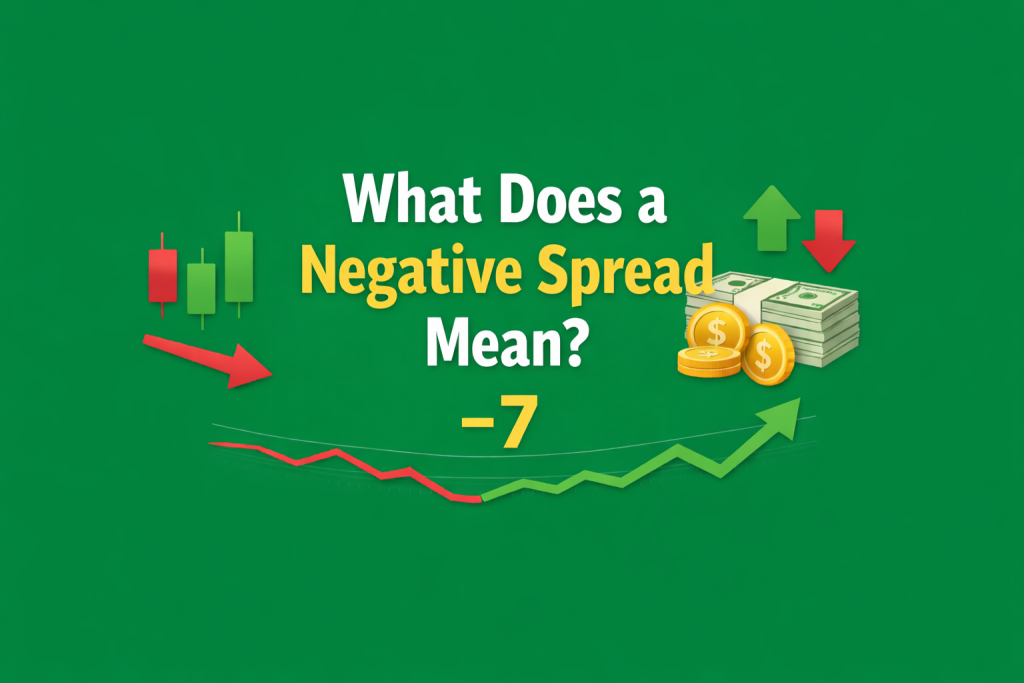
What Does a Spread of -7 Mean?
This is the part that confuses most traders.
what does a spread of -7 mean
It means the bid price is temporarily higher than the ask price. In simple words, the price to sell is higher than the price to buy. This creates a negative number when calculating spread.
Example:
- Bid price: 1.1007
- Ask price: 1.1000
- Spread: -7 points
This situation usually lasts for a very short time and happens due to fast price updates from liquidity providers.
How Can Bid Be Higher Than Ask?
Under normal conditions, this should not happen. But in real markets, prices change extremely fast. Here are the main reasons:
1. Fast Market Movements
When prices move very quickly, bid and ask updates may not arrive at the same time.
2. Multiple Liquidity Providers
Different banks and institutions provide prices. Sometimes their quotes overlap.
3. ECN and Raw Spread Accounts
ECN brokers connect you directly to the market. This makes spreads dynamic and sometimes unusual.
If you want to understand how spreads and price updates appear in real time, learning how to use MetaTrader 4 properly can make trading much clearer.
Is Negative Spread a Broker Trick?
In most cases, no.
Negative spread usually appears with:
- Regulated brokers
- ECN or raw spread accounts
- High-volume trading sessions
However, traders should always use trusted brokers and check trading conditions carefully.
When Does Negative Spread Usually Appear?
Negative spread does not happen randomly. It appears in specific situations.
High-Impact News Events
Examples include:
- Interest rate decisions
- Inflation data
- Employment reports
During these times, price changes are extremely fast.
Market Session Overlaps
When London and New York sessions overlap, liquidity is high and spreads can behave differently.
Sudden Liquidity Gaps
Late market hours or unexpected events can create price imbalance.
Some currency pairs are more stable than others, which is why choosing the right pair can help reduce sudden spread changes.
Is Negative Spread Good for Traders?
This depends on how you trade and your experience level.
Possible Benefits
- Lower entry cost
- Faster break-even point
- Better price execution in rare cases
Hidden Risks
- Slippage
- Orders not filled at expected price
- Sudden spread widening right after entry
Many beginners focus only on the benefit and ignore the risks.
Can You Make Free Profit from Negative Spread?
This is a common myth.
Even if spread is negative:
- Execution delay can remove the advantage
- Slippage can reverse the benefit
- Market can move against you instantly
There is no guaranteed free profit in trading.
Why Beginners Should Be Careful
Negative spread looks attractive, but beginners should be cautious because:
- They may overtrade
- They may increase lot size
- They may ignore risk management
Professional traders focus on strategy, not temporary spread behavior.
Using high leverage during volatile market conditions can increase risk, especially when spreads behave unpredictably.
How Professional Traders Handle Negative Spread
Experienced traders:
- Do not chase negative spreads
- Use strict stop losses
- Focus on overall market structure
- Trade only during planned sessions
They understand that spread is only one small part of trading success.
ECN vs Market Maker: Understanding the Spread Difference
When choosing a broker, understanding how spreads work under different broker models is very important. The two most common types are ECN brokers and market maker brokers. Each model handles spreads differently, and knowing this helps traders make better decisions.
ECN Brokers
ECN (Electronic Communication Network) brokers connect traders directly to liquidity providers such as banks and financial institutions. Because prices come straight from the market, spreads are variable and change based on supply and demand.
In fast-moving market conditions, ECN accounts may even show a negative spread for a short time. These brokers usually charge a commission per trade instead of increasing the spread. Execution is often faster, which is why ECN brokers are commonly preferred by experienced and professional traders.
Market Maker Brokers
Market maker brokers set their own prices and often offer fixed or semi-fixed spreads. This makes trading costs more predictable, especially for beginners. Negative spread is rare with this model because prices are controlled internally.
Market makers usually earn money through the spread itself rather than charging a separate commission. While execution may be slightly slower during high volatility, many regulated market makers provide stable trading conditions for retail traders.
Which One Is Better?
Neither ECN nor market maker brokers are “good” or “bad” by default. The most important factors are broker regulation, transparency, and execution quality. Traders should choose a broker based on their experience level, trading style, and risk management approach—not just on spread size.
Trading with brokers that offer consistently low spreads can reduce costs and make unusual spread behavior easier to manage.
Does Negative Spread Affect Stop Loss and Take Profit?
Yes, negative spread can affect stop loss and take profit orders, especially during high-volatility market conditions.
When the market is moving fast, price updates can change quickly. In such situations, a stop loss may trigger earlier than expected, or a take profit order may not fill at the exact price you set. This usually happens because of rapid price changes, spread fluctuation, and execution speed during volatile moments.
Risk Management Still Matters More Than Spread
Many traders pay too much attention to spread and ignore the most important parts of trading. While spread affects trading cost, it does not decide long-term success. What really matters is how well a trader manages risk.
Using the right lot size, maintaining a healthy risk-to-reward ratio, and controlling maximum drawdown help protect the trading account over time. Just as important is emotional discipline, because fear and greed often cause bigger losses than spread ever could.
Even a zero-spread trading account cannot save a trader who follows a weak strategy or ignores proper risk management.
How to Protect Yourself as a Trader
Here are simple steps to stay safe:
- Use regulated brokers
- Avoid trading during major news if beginner
- Never over-leverage
- Test broker behavior on demo account
- Read broker execution policies
Common Myths About Negative Spread
Myth 1: Negative spread means broker error
→ Not true in most cases
Myth 2: Only professionals see negative spread
→ Anyone on ECN accounts can see it
Myth 3: Negative spread guarantees profit
→ Completely false
Should You Change Your Strategy Because of Negative Spread?
No, you should not change your trading strategy just because of negative spread.
A strong trading strategy is designed to work in different market conditions, not only during rare situations like negative spread. It does not rely on spread tricks or temporary pricing behavior. Instead, it focuses on consistency, risk control, and long-term performance.
If a strategy only works when the spread turns negative, it is not reliable and can fail quickly when market conditions return to normal.
Final Thoughts: Is Negative Spread Something to Fear?
Negative spread is not magic and not dangerous by default. It is simply a result of how modern electronic markets work. For experienced traders, it is just another market behavior. For beginners, it can be confusing and risky if misunderstood.
The smart approach is to focus on learning, discipline, and long-term consistency instead of chasing unusual market conditions. Understanding spread behavior improves awareness, but it should never replace proper trading education and risk control.
Disclaimer
This article is for educational purposes only and does not provide financial or investment advice. Trading involves risk, and market conditions can change rapidly. Always do your own research, understand your broker’s terms, and trade responsibly.
Frequently Asked Questions
Should traders change strategy because of negative spread?
No, a strong trading strategy should not depend on temporary spread behavior.
What is a spread in trading?
A spread is the difference between the buy price (ask) and the sell price (bid). It is the basic cost of opening a trade.
Can a trading spread be negative?
Yes, a spread can become negative for a short time during fast market movements or high liquidity situations.
Does negative spread mean free profit?
No. Negative spread does not guarantee profit because slippage, execution delay, and sudden price changes can remove any advantage.
Is negative spread safe for beginners?
It can be risky for beginners because fast market conditions can cause losses if proper risk management is not used.
Which brokers usually show negative spread?
Negative spread is mostly seen on ECN or raw spread accounts offered by regulated brokers with direct market access.
Does negative spread happen all the time?
No, it happens rarely and usually during news events, high volatility, or session overlaps.
Can stop loss be affected by negative spread?
Yes, during volatile conditions, stop loss and take profit levels may trigger differently than expected.