
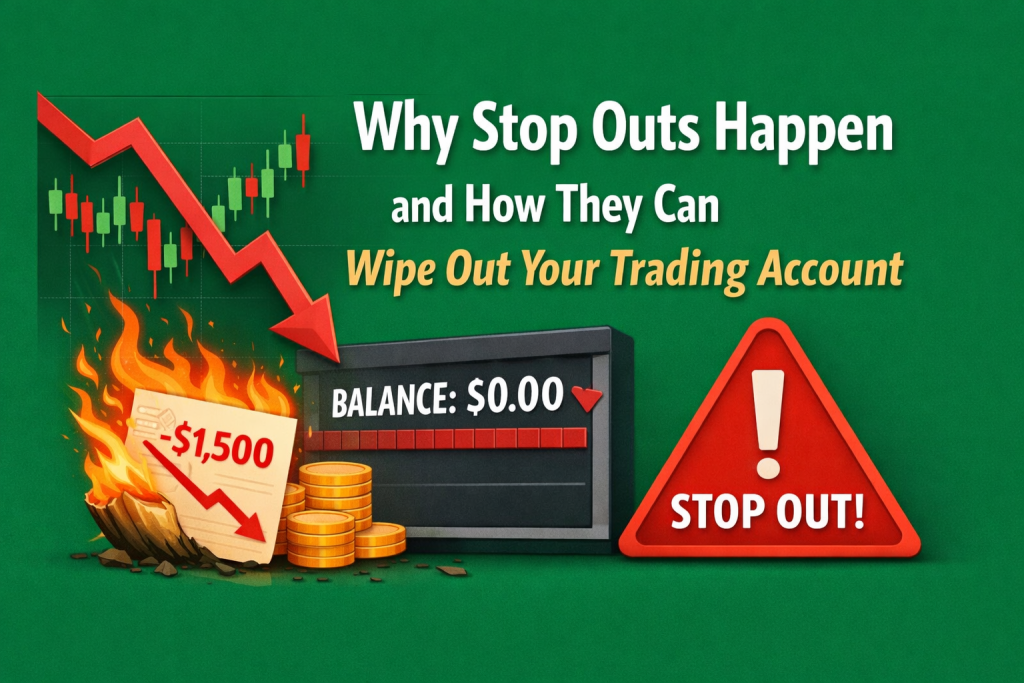
Stop Out in Trading: The Shocking Reason Your Trades Disappear Overnight
One moment your trade looks normal on the screen.
The next moment, it disappears — without you clicking a single button.
No loud warning.
No final confirmation.
Just an empty chart and a balance that suddenly feels painful to look at.
Almost every trader experiences this shock at least once. In fact, many don’t even understand what went wrong. They only know that the market took control and their position was closed without permission. For beginners, this moment feels unfair. For experienced traders, it becomes a turning point.
This is the point where trading stops being a game and starts becoming a serious skill — or where many people quietly give up. In this article, we’ll break down this reality honestly, using real trading logic, simple language, and practical experience, so you can understand what happened and how to protect yourself from it in the future.
What Is a Stop Out in Trading and Why Brokers Force Close Your Trades
In simple terms, a stop out is a built-in safety system used by brokers to protect trading accounts from complete collapse. When your account no longer has enough available money to keep trades open, the platform steps in and closes positions automatically.
This does not happen because a broker wants to take your funds.
It happens because your losses have reached a level where your account is close to going negative.
At this stage, the broker is protecting both you and itself from a situation where losses become uncontrollable. The system follows strict rules, not emotions.
Many beginners confuse this with a stop loss, but the difference is critical. A stop loss is a decision you make before or during a trade. A stop out, on the other hand, is never your choice. It happens when losses grow so large that your usable balance, also known as free margin, drops below a specific level defined by the broker’s risk rules.
Understanding this difference early can save you from repeating one of the most common and expensive trading mistakes.
Stop Out Meaning in Trading Explained With a Real Account Example
Let’s remove all confusion by walking through a real-world style example that many traders can relate to.
Imagine you start with an account balance of $1,000. Feeling confident, you open a relatively large position using high leverage. At first, everything looks fine, but then the market moves in the opposite direction.
As price continues against you, your floating loss slowly grows and eventually reaches $700. At this point, your usable money is dangerously low. Most of your balance is now locked, and your free margin is almost gone.
If your broker’s stop-out level is set at 20%, the system constantly monitors your margin level. The moment it drops below that threshold, the platform acts instantly. There is no confirmation box, no manual approval, and no waiting time.
The broker doesn’t ask you. The broker doesn’t pause the trade.
The system automatically closes your largest losing position.
This is the stop out meaning in trading in its clearest form — a forced safety action designed to stop losses from becoming even more dangerous when risk goes out of control. Platforms automatically close trades when your margin is too low. You can see a simple explanation here: stop-out risk management
Stop Out vs Margin Call: The Costly Difference Most Traders Learn Too Late
This confusion has destroyed more trading accounts than bad strategies ever did.
A margin call is not a punishment. It is a warning.
A stop out, on the other hand, is action.
When your account starts moving toward danger, the trading platform alerts you first. This is your critical window to take control. At this stage, you still have options. You can close one or more losing trades, add funds to increase available margin, or reduce overall risk exposure.
If this warning is ignored, the system moves to the next step. There are no negotiations and no second chances. The platform forcefully closes trades to protect the account from deeper losses.
Think of it this way:
Margin call means, “Your risk is too high — fix it now.”
Stop out means, “You didn’t act, so we stepped in.”
Professional traders take margin calls seriously and act immediately. Beginners often ignore them, hoping the market will turn around. That single mistake is often the reason accounts don’t survive long enough to grow.
Why Traders Get Stopped Out So Often
Getting stopped out is not about being unlucky. In most cases, it is the result of the same mistakes repeated again and again.
One of the biggest reasons is over-leverage. High leverage feels exciting and powerful, especially for new traders, but it quietly magnifies losses. Even a small market move in the wrong direction can drain free margin faster than expected.
Another common reason is emotional trading. Revenge trades after a loss, holding positions out of hope, or refusing to accept a small loss often push traders into dangerous territory. Emotions cloud judgment, and risk control disappears.
Many traders also trade without a clear risk plan. Entering trades without knowing how much of the account is at risk is like driving at high speed with no brakes. Sooner or later, something goes wrong.
Finally, there is the habit of holding losing trades. Some traders convince themselves that the market must come back. Sometimes it does — but many times it doesn’t. When price keeps moving against the position, the account ends up paying for that belief.
Ask any experienced trader, and you’ll hear the same story. This pattern repeats itself in accounts across all markets, again and again.
Stopped Out Meaning in Trading: The Emotional Side No One Talks About
Getting stopped out hurts — and not just financially, but mentally as well.
It feels sudden.
It feels unfair.
And for many traders, it feels embarrassing.
The stopped out meaning in trading goes far beyond account numbers and charts. It shakes confidence, creates self-doubt, and makes traders question whether they are even capable of trading successfully. This emotional impact is something most trading courses never talk about, yet almost every trader experiences it.
Here is the truth that most professionals agree on: being stopped out does not mean you are a bad trader. It simply means your risk exposure was larger than what your account could safely handle at that moment.
Once traders understand this, something important changes. They stop blaming the market and start analyzing their system, position sizing, and risk limits. That shift in mindset is often the first real step toward long-term improvement.
Stop Out Trading Rules Every Trader Must Know
Every broker applies stop-out rules, but these rules are not universal. Understanding them is part of trading responsibly.
One key point to remember is that stop-out levels can vary widely. Some brokers trigger it at 20%, others at 30% or even 50%. When that level is reached, the broker automatically closes trades — without asking for confirmation.
In most cases, the system closes the largest losing positions first to reduce risk as quickly as possible. Once this process begins, it cannot be cancelled, paused, or reversed.
This is why reading broker conditions is not optional. Ignoring stop-out rules is like signing a contract without reading the terms. The rules still apply — whether you understand them or not.
How to Avoid a Stop Out in Trading: Practical Tips That Work
Avoiding a stop out is not about predicting the market or trying to be “lucky.” It’s about managing risk better than the market can punish you. The most successful traders focus on controlling what they can control — their own strategy, position size, and emotions.
Here are some proven habits used by experienced traders to stay safe and keep accounts alive:
1. Use Proper Position Size
Never put a large portion of your account on a single trade. Even a small market move against you can become catastrophic if your positions are too big.
2. Keep Free Margin Healthy
Always leave room in your account for unexpected price swings. Trading on tight margins is like driving a car on the edge of a cliff — one mistake, and it’s over.
3. Respect Losses Early
Accept small losses as part of the game. Trying to recover huge losses quickly only leads to bigger problems. Discipline with early losses is what separates beginners from professionals.
4. Avoid Emotional Decisions
Anger, frustration, or desperation are some of the fastest ways to increase risk. If emotions are high, step away from the market. Pause. Breathe. Protect your capital.
5. Trade With a Plan
A written trading plan removes guesswork and impulsive decisions. When you know exactly how much risk you are taking on each trade, stop-out risk decreases significantly.
These habits don’t make trading glamorous or exciting, but they make it sustainable. Long-term success isn’t about big wins every week — it’s about surviving losses, controlling risk, and growing steadily over time.
Can a Stop Out Ever Be a Good Thing?
It might sound strange, but the answer is yes — a stop out can actually be a blessing in disguise for your trading journey.
Here’s why:
- Prevents Total Account Wipe-Out: A stop out stops losses from growing uncontrollably, protecting the remainder of your account from complete destruction.
- Forces Discipline: It teaches you to respect risk limits and avoid reckless trades.
- Exposes Bad Habits: Holding trades too long, over-leveraging, or ignoring risk management becomes painfully obvious.
Many successful traders openly admit that their worst stop-out experience taught them the most valuable lessons about trading. In a strange way, the market is sometimes protecting you from yourself.
The key is to learn from it, not repeat it. Each stop out is feedback — a signal to refine your strategy, control risk better, and approach the market with discipline. Once you embrace this perspective, a stop out stops being a failure and becomes one of your most important learning tools.
Stop Out Trading in Forex, Indices, and Crypto: Why Market Type Matters
Not all markets are created equal, and understanding their behavior is crucial to managing stop-out risk.
- Forex usually moves steadily, but high leverage can turn small moves into account-threatening losses.
- Indices can spike sharply during news releases or trading sessions, catching traders off guard.
- Crypto is famously volatile — stop outs can happen almost instantly if risk is mismanaged.
This is why stop out trading risk increases dramatically in fast-moving markets. The faster the price moves, the quicker your free margin disappears. Learning how each market behaves is not just academic — it’s a critical part of professional growth. Traders who understand volatility and leverage survive longer, while those who ignore it often face repeated stop outs.
What Is a Stop Out in Trading for Beginners: A Simple Reality Check
For beginners, the concept of a stop out can feel scary — almost like a hidden trap in the market. But it shouldn’t be ignored or feared.
So, what is a stop out in trading for someone just starting out?
It’s a clear reminder that trading is not about guessing the market direction. Instead, it’s about managing risk in a way that the market cannot punish you beyond your account’s limits. A stop out happens when your risk exceeds your capacity — nothing personal, just a system at work.
Once beginners truly accept this, their mindset shifts. They start seeing trading as a skill to manage risk and survive, rather than just a gamble for profits. This shift is often the first major step toward becoming a consistent and disciplined trader.
Final Thoughts: The Hard Truth Most Traders Learn Too Late
Trading is not about being right on every trade. It’s about surviving long enough to grow, learn, and improve.
Accounts don’t fail because of a single losing trade. They fail because of repeated mistakes — poor risk management, over-leveraging, and ignoring warning signs. The truth is simple: the market doesn’t destroy accounts — traders do, by neglecting risk.
If there’s one lesson to take away from this article, let it be this:
Learn early, trade smart, and protect your capital at all costs.
Treat every trade as a lesson, respect your risk limits, and focus on long-term survival rather than short-term wins. Those who master this mindset are the traders who endure, grow, and eventually succeed.
Disclaimer:
This article is for educational purposes only and does not constitute financial or trading advice. Trading carries significant risk; always research, manage risk, and consult a licensed professional before trading real money.
FAQs on Stop Out in Trading
What is a stop out in trading?
A stop out happens when your broker automatically closes your trades because your account does not have enough free margin to keep them open.
How is a stop out different from a stop loss?
A stop loss is your decision to limit losses. A stop out is forced by the broker when your account risk becomes too high.
Can I prevent being stopped out?
Yes, Proper risk management, correct position sizing, and keeping enough free margin can help you avoid stop outs.
Do all brokers have the same stop-out level?
No, Stop-out levels vary between brokers, usually ranging from 20% to 50% of margin. Always check your broker’s rules.
Is being stopped out a bad thing?
Not always. It can protect your account from larger losses and teach you important risk management lessons.



1 thought on “Why Stop Outs Happen and How They Can Wipe Out Your Trading Account”
Pingback: Buy Stop or Sell Stop? Why Most Beginners Lose Trades Before Entry | GuriFx